You don't have a discipline problem.
You have a context problem.
Here's where it shows up.
The Morning Rebuild
You open your laptop and spend the first 30 minutes reconstructing where you were — what you decided, what you promised, what was on fire. The work doesn't start until the remembering ends.
The Stranger Loop
You explain your business to your AI for the tenth time this week. It gives you a brilliant answer for someone who isn't you — because it has no idea who you are or what you already decided.
The Dropped Thread
The follow-up you swore you'd send, the loop you meant to close — gone the second something louder landed. You don't find out it slipped until the person you let down reminds you.
The Context Tax of Wearing Every Hat
You're the strategist, the closer, the operator, and the one who remembers the client's kid's name — and switching between them costs you something every time. Nothing hands you the thread when you change roles, so you carry it all yourself.
The Quiet Drift
You said this quarter was about two things. Six weeks in, you're buried in a third that felt urgent, and nothing in your system noticed you'd walked away from what you committed to. Your tools are happy to help you drift — they were never built to stop you.
Caught Flat
Someone asks where things stand and you stall — not because you don't know, but because the answer is scattered across six threads, two apps, and your memory of a call from last Tuesday. The information exists. Nothing assembled it for you.
You've felt the wow. Then it faded.
You've used ChatGPT. You've tried Claude. The first conversation was electric. The tenth was frustrating. Every session starts at zero. Your AI doesn't know your priorities, your clients, or what you decided yesterday.
That's not a tool problem. It's an architecture problem.
Refracted Cortex is the architecture layer. It sits on top of the leading AI models — Claude, GPT, Gemini — and makes them actually know you — your values, your commitments, your patterns, and your priorities. Not for one conversation. Permanently.
Refracted Cortex isn't a better chatbot.
It's a different kind of system.
Chatbots answer. RC remembers.
Tools reset every session. RC compounds across them.
Assistants agree. RC pushes back.
Other AI waits to be asked. RC watches what's slipping.
Most AI lives in one chat window. RC holds your whole week.
See it in action
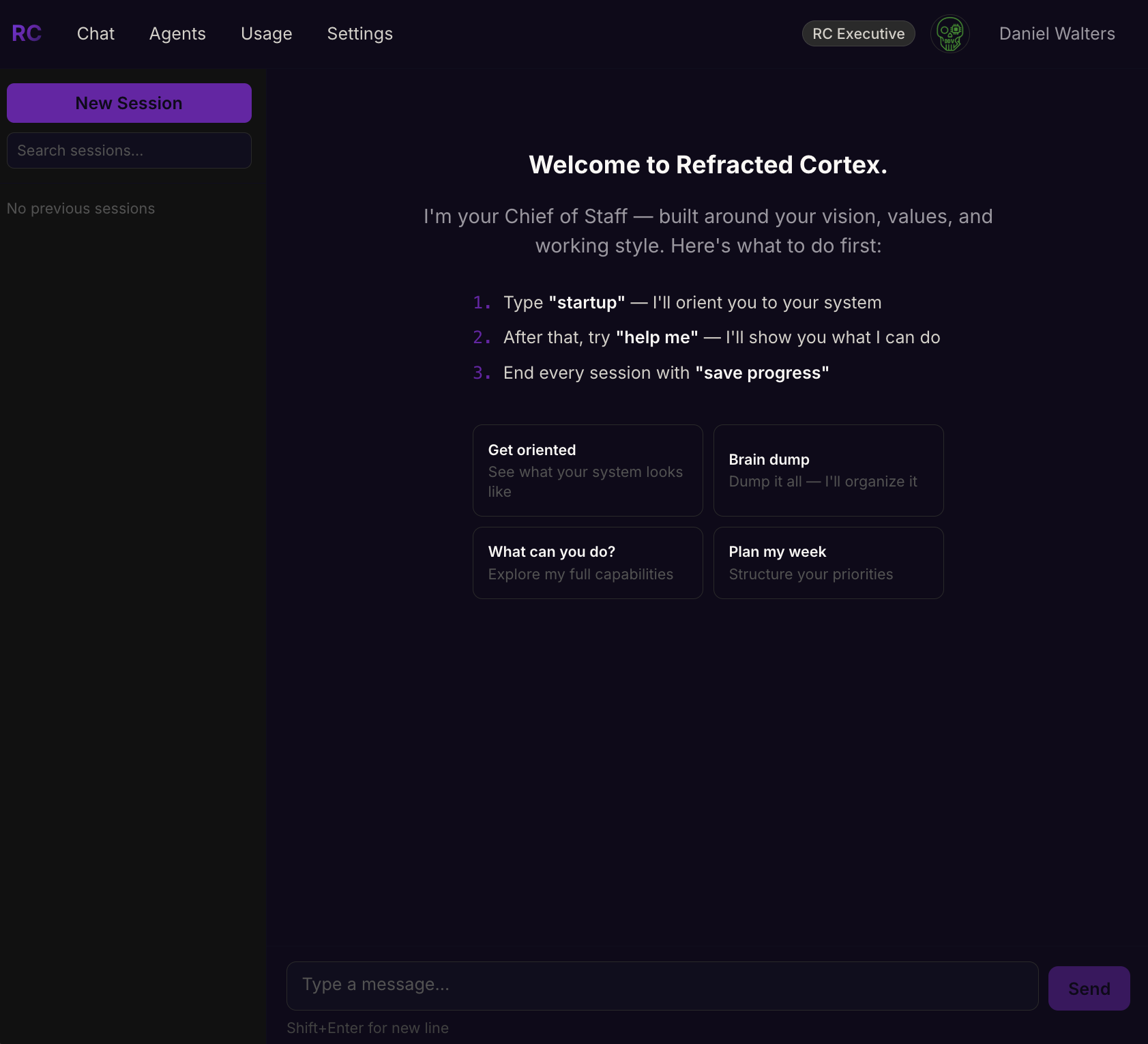
Four minutes. One startup, one brain dump, one moment where the system caught what the user couldn't see, and one save. That's what an always-on Chief of Staff looks like in practice.
Video demo coming soon.
“Allowing it to provide me good questions — and I’m like, oh, that’s actually good. I hadn’t thought about that.” — Parker Pursell, Pursell Brand
How it actually works
1. It knows you.
During onboarding, you define your values, working style, priorities, and decision patterns. This becomes your cognitive profile — the foundation everything else builds on. Not a system prompt. A living document that evolves as you do.
2. It remembers everything.
Decisions, commitments, open loops, context from last week and last month. When you come back tomorrow, it picks up where you left off. No rebuilding. No "as I mentioned earlier." It already knows.
3. It pushes back.
When your decisions don't match your stated values, the system says so. When you're overcommitting, it flags it. This isn't a yes-machine. It's an accountability partner that actually knows what you said you'd do.
This is what cognitive architecture means: a system built from psychology, not programming, that externalizes how you actually think and work. It holds your context, protects your boundaries, and compounds over time — so next month's AI is smarter than this month's.
In 2026, researchers in Nature Reviews Psychology argued that human–AI interaction should be grounded in psychological theory — that psychology, not the latest model, is what makes insight durable. RC is built on the same conviction, applied to design rather than research: psychology as the operating logic, not an afterthought. And right now, nobody else is building identity-loaded, values-governed cognitive architecture for non-developers. This is a field of one.
$97/mo for your Chief of Staff.
- Chief of Staff agent — knows you, pushes back, tracks commitments
- Always-on heartbeat — surfaces what's slipping
- AI compute included — top up anytime or bring your own key
- Persistent memory, session continuity, multi-source intake
- 30-day operational guarantee
The doing isn't the work anymore.
The thinking is.
This is the system that proves it.
"I didn't build this to sell. I built it because I needed it. I'm late-diagnosed ADHD and autistic. My brain generates ideas faster than I can organize them. So I built a system that organizes with me — not for me. It grew into something that runs my entire consulting practice. The principles behind it are universal." — Daniel Walters, Founder
Ready to stop starting from scratch?
Founding access is limited to the first 10 members — the first 10 to complete their trial and first paid month get the Connected Intelligence course (a $297 value) free.
Start Free Trial What is cognitive architecture?